"Flood Irrigation: YES / NO. NAME OF PROVIDER."
That line sits in the services section of the Arizona REALTORS® Residential Seller's Property Disclosure Statement. The February 2023 version is still the current one listed on the association's residential resale forms page as of September 2026. Most of the Phoenix metro fills in that provider field without a second thought. In Arcadia the answer can take a little digging, because two different organizations have delivered water to these lots for more than a century. Whichever one serves a parcel sets the bill, the schedule, and the paperwork that comes with the deed.
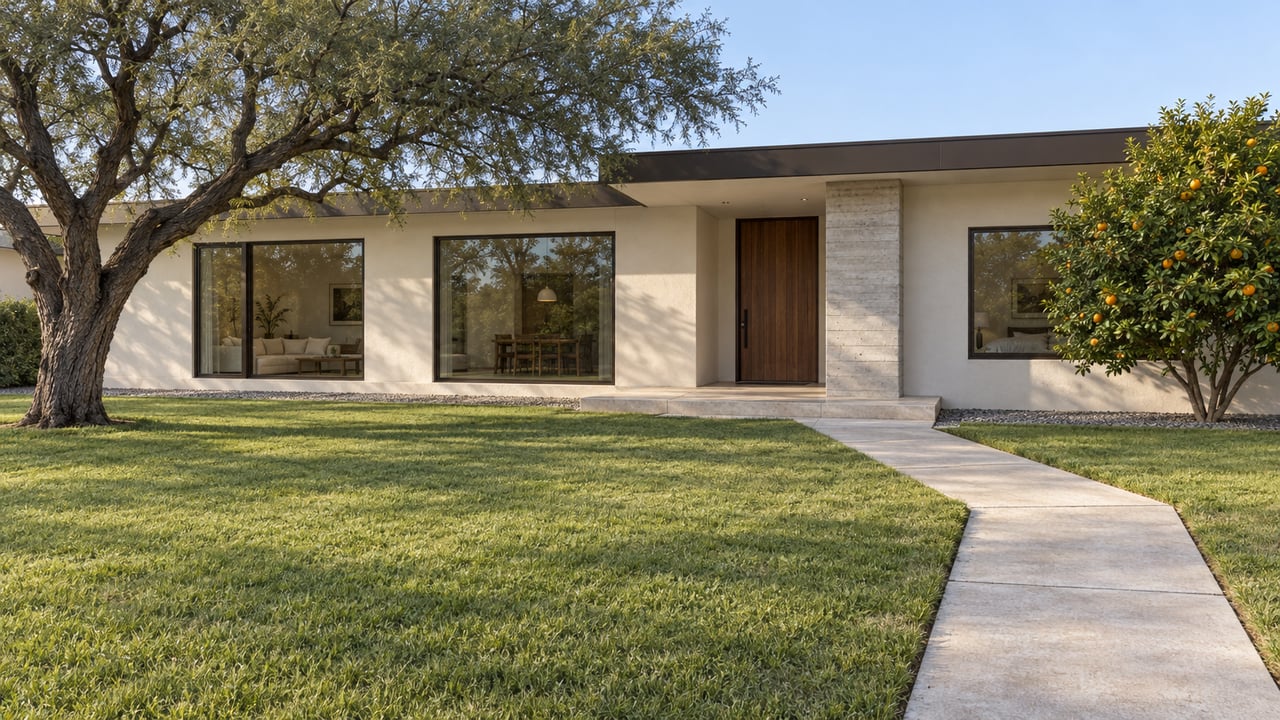
A buyer touring Arcadia sees mature citrus, deep green lawns, and big lots. What the buyer is actually taking on is a share of a neighbor-run water system. Who sits at the head of that system depends partly on decisions made before most of these houses existed.
A slope, a canal, and a private water company
The Arcadia tract was first recorded in December 1919. East of 56th Street it was divided into lots of about ten acres, and west of 56th Street into lots of about five acres. The developers expected buyers to "engage in the growing of citrus fruits," according to the neighborhood history published by the Arcadia Camelback Mountain Neighborhood Association, which draws on the City of Phoenix's 1999 Arcadia Camelback Special District Plan.
Orchards need water, and the Arizona Canal ran close by. The same history says that because of how the land sloped, only lots south of Camelback Road could actually use the canal. So the developers, led by Seymour Jordan, formed the Arcadia Water Company in 1919 and built pumping plants capable of supplying 2,100 acres. By 1924, crews had laid fifteen miles of underground concrete pipe. The building that now houses the Shemer Art Center and Museum went up in 1919 as the home of the water company's foreman.
The Camelback split is a historical account, and neither organization publishes a parcel-by-parcel boundary that matches Camelback Road. SRP sends anyone asking about a specific property to its service area page, where you enter an address to see which services reach it. The 1919 decision still explains why the SPDS provider field in Arcadia can hold one of two different names.
Two organizations, one shared obligation
The company still operates. Arcadia Water Company describes itself as an Arizona nonprofit, incorporated in 1919 to supply irrigation water only to its members, and governed by an elected 11-person board. Three board seats come up each year at an annual meeting held on the third Tuesday of April. Its water comes from wells. A 2024 regional groundwater monitoring report, issued in February 2025, counted five AWC wells that together pumped 1,854 acre-feet during 2024.
SRP delivers surface water from its reservoir and canal system. Its spring 2026 residential newsletter put reservoir storage at 57% of capacity as of March 3, 2026, compared with 70% a year earlier.
Here is what each organization's own published material says about the points a buyer would ask about:
| Question | SRP | Arcadia Water Company |
|---|---|---|
| Water source | Reservoir and canal system | Company-owned wells, pumping plant, and reservoir |
| Who holds the right | Water rights belong to the land | Landowners in the district hold the rights, conditioned on membership and charges |
| Published entry cost | $25.90 new account fee, $8.10 name change fee per deed | $100 membership fee |
| Published usage charges | Annual rate schedule, per account and per acre | Charges for water, delivery service, or repair; amounts not posted |
| What the provider maintains | The canal system up to the neighborhood gate | Wells, main lines, main diversion boxes, some laterals |
| What owners maintain | Ditches, channels, or pipes from the gate to each property | Sub-distribution systems inside subdivisions, owned by members or their HOA |
The last row is the same under either provider. SRP says plainly that homeowners and their neighbors, not SRP, install, operate, and maintain the private infrastructure that runs from the delivery gate to each yard. AWC says the same about the subdivision-level pipes that carry its water to members' land. So the provider changes the paperwork and the bill, while the last stretch of pipe is shared by the street either way.
The bill that shows up in mid-November
For SRP-served lots, the timing matters this fall. SRP bills irrigation annually for the coming calendar year. Bills generally go out in mid-November and are due the first week of December, and unpaid basic charges accrue a 1% monthly penalty. SRP's Calendar Year 2027 residential charge summary, dated March 2026 and subject to annual board approval, lists the amounts due December 6, 2026. Owners can also choose a minimum payment split between that date and June 6, 2027.
| Water acres | Delivery fee | Basic charge | Subdivision water fee | CY2027 total |
|---|---|---|---|---|
| 0.20 | $97.43 | $11.23 | $57.34 | $166.00 |
| 0.40 | $97.53 | $22.46 | $114.67 | $234.66 |
| 0.60 | $97.62 | $33.70 | $172.01 | $303.33 |
| 0.80 | $97.72 | $44.93 | $229.34 | $371.99 |
| 1.00 | $97.81 | $56.16 | $286.68 | $440.65 |
The delivery fee barely changes with lot size, so how heavily it weighs on the bill depends on the acreage. On a 0.20-acre lot it accounts for roughly 59% of the $166.00 total. On a full acre it drops to about 22% of $440.65. Per acre, the smaller lot pays about $830 and the one-acre lot about $441. The large parcels Arcadia was platted for still get the better per-acre math on SRP's schedule.
Rates moved up from calendar year 2026 to 2027. The per-account delivery fee rose from $93.87 to $97.34, and the base charge for stored and developed water rose from $53.52 to $56.16 per acre. The ownership-change fees did not move. The name change fee is $8.10 per deed and the new account fee is $25.90 in both years. A sale between now and early December overlaps the window when the 2027 bill is issued, and the purchase contract decides how that bill gets handled between the parties.
AWC does not publish a comparable table. Its site lists the $100 membership fee and says members may also owe charges for water, delivery service, or repair, without giving amounts. For an AWC-served parcel, the figures come from the company directly. Its site lists the office email as [email protected].
What a delivery turn actually involves
The bill only covers part of what comes with flood irrigation. The rest is the schedule. SRP's residential subdivision accounts get water roughly every 14 days from April through September and every 28 days from October through March, with no deliveries during canal maintenance. As of today, October 12, SRP lots are on the longer winter interval. SRP schedules water around the clock, holidays included, and posts neighborhood schedules and order deadlines in its app and in SRP My Account. A recurring-order option is also available.
AWC posts its own schedules. Its current Group A schedule sets timed turns from October 12 to 15, 2026, some in the daytime and some in the evening.
On SRP's system, a turn follows a set sequence:
- Check the neighborhood gates about 30 minutes before the turn.
- Coordinate with the neighbor whose turn comes just before yours.
- Open your yard valve or ditch port at your scheduled start time.
- Let the next neighbor know when your turn is close to ending.
- Close the valve or replace the port cover when it ends.
A typical delivery covers the yard in two to three inches of water that soaks deep into the soil. Water is ordered in five-minute increments, up to the property's allocation. SRP notes that this deep soaking helps trees grow deep roots.
The pipe a buyer co-owns
The yard itself is part of the system. Under SRP's guidance, berms have to hold the ordered water on the owner's land, valves stay closed except during that owner's turn, and yards may need leveling or aeration so water spreads evenly. Open ditches may need cleaning about every other month in winter and every other week in summer. Leaks, clogged pipes, and damaged gates can interrupt deliveries or flood a property, and SRP describes repairs as a shared neighborhood responsibility.
Neighborhoods arrange that shared responsibility in different ways. SRP describes Irrigation Water Delivery Districts as one option: county special taxing districts that some neighborhoods form to maintain their systems. Our research did not confirm a specific one in Arcadia. Under AWC, the subdivision pipes belong to the members or their homeowners association.
The SPDS reaches into this too. Beyond the provider line, it asks sellers about problems with the irrigation system, water-related damage, drainage and grading, assessments, and associations. Its instructions also tell buyers to look into any answers left incomplete. In Arcadia, a full answer to the irrigation questions covers the provider, the account, the schedule, and who maintains the stretch of pipe between the gate and the lawn.
FAQ
Does the water right transfer with the house? SRP says irrigation water rights belong to the land, and its fee schedule includes an $8.10 name change fee per deed. AWC says landowners in its district hold the rights as long as the $100 membership fee and any charges are paid, under the company's rules. It does not publish instructions for transferring membership after a sale.
How often does water arrive in winter? SRP subdivision accounts get water about every 28 days from October through March. AWC posts dated delivery schedules for its members on the company's website.
Can I tell the provider from the street address? SRP's service area lookup shows which SRP services reach a given address. For a parcel that may be in the Arcadia Water Company district, the company itself is the source, because it does not publish a boundary map.
If you're getting ready to sell an Arcadia home with flood irrigation, Chad & Cara Dankberg can help you gather the provider name, account details, delivery schedule, and maintenance history before the first buyer asks, so the SPDS answers are complete when the listing goes live. Request a Selling Consultation and we'll go through it with you.
This article is general information, not legal, tax or financial advice. Consult a qualified professional about your situation.